D’Nuri Residences @ Desa Petaling
A completed 557-unit tower with a single 850 sq ft three-bedroom layout and a government price cap of RM300,000. This is a Federal Territories affordable housing scheme — not open to foreign buyers at any price, and not open to most Malaysian buyers either. Read the eligibility rules before you read anything else.
⚡ Typical reply within 15 minutes, 9am–10pm MYT · No obligation


D’Nuri Residences @ Desa Petaling at a glance
Two rows above decide whether the rest of this page is relevant to you. The scheme row and the foreign buyers row. Residensi Wilayah is a citizens-only programme with an income ceiling, run by the Federal Territories Department rather than by the developer, and a unit bought under it carries a ten-year restriction on the title. A non-citizen cannot buy one at launch and cannot buy one in the subsale market either, because Kuala Lumpur’s minimum purchase price for foreign buyers is RM1,000,000 and this building was priced at RM300,000. Everything else here comes from the Federal Territories Department’s own project record or from EXSIM’s own pages, and I have labelled which is which.
- Development
- D’Nuri Residences @ Desa PetalingRegistered with the government as Pangsapuri Nuri Desa Petaling
- Scheme
- Residensi Wilayah — Federal Territories affordable housingAdministered by Jabatan Wilayah Persekutuan, not by the developer
- Developer of record
- Aspire Causeway Sdn BhdEXSIM Group; portals name a different EXSIM entity
- Land
- Lot PT15622, Jalan 2/125Mukim Petaling, Daerah Kuala Lumpur, 57100
- Total units
- 557The number of units opened for application
- Storeys
- 44 on the government registerProperty portals say 42 — see the correction section
- Layout
- One type only — 850 sq ftThree bedrooms, two bathrooms
- Selling price when new
- RM300,000The Residensi Wilayah ceiling price, not a starting price
- Tenure
- Not published by developer or governmentPortals say leasehold; get a title search before you commit
- Expected completion on the register
- 25 June 2020Site progress photographs run to Q3 2020
- Application window
- 4 Oct 2016 to 28 Nov 2018Closed — the government portal now shows Permohonan ditutup
- Foreign buyers
- No — and not closeKuala Lumpur floor is RM1,000,000; this is a RM300,000 citizens-only scheme
- Resale restriction
- Ten-year moratoriumTransfer needs government consent except to spouse or children
- Landmark on the register
- Plaza Salak ParkThe only landmark either source names
Explore related topics
Curated hubs, each with its own guide — not auto-generated tag archives.
Six things that decide whether D’Nuri is even available to you
Almost every other project page on this site opens with location or price. This one has to open with eligibility, because a majority of the people who read it will not be permitted to buy here regardless of what they are willing to pay. That is not a criticism of the building. It is the whole design intent of the programme it was built under, and pretending otherwise would waste your afternoon.
Non-citizens: no, and there is no workaround
Two independent rules both block it. The first is federal. Kuala Lumpur sets a minimum purchase price of RM1,000,000 for a non-citizen acquiring residential property, and consent runs through the Jawatankuasa Kerja Tanah Wilayah Persekutuan Kuala Lumpur — the Land Working Committee, under section 433B of the National Land Code. A unit sold at RM300,000 is nowhere near that line. The second is the programme. Residensi Wilayah requires the applicant to be a Malaysian citizen, so the original purchase was never open to a foreign passport holder in the first place. In Malaysian land law the phrase foreign interest also captures Malaysian permanent residents, so holding PR does not move you across either line. Any agent who suggests a nominee arrangement is proposing something that will not survive a title search.
Malaysian citizens: eligibility is tighter than most people expect
The Residensi Wilayah criteria published by the Federal Territories Department require the applicant to be a Malaysian citizen aged at least 21 at the time of application, and to have been born in, work in, or reside in the Federal Territories. There is an income ceiling: gross household income not exceeding RM10,000 a month for a single applicant and RM15,000 a month for a married couple. Applications for this particular project opened on 4 October 2016 and closed on 28 November 2018, and the portal now shows the window as closed. So today the only route in is the subsale market — and that route has its own gate, which is the next card.
The ten-year moratorium is the single most important thing here
A Residensi Wilayah unit carries a restriction preventing sale or transfer for ten years without government consent, with an exception for transfers to immediate family such as a spouse or children. Letting the unit to a Malaysian citizen tenant is permitted. Work out what that means in practice: if the first owners took possession around 2020, the earliest ordinary resale window opens around 2030. Any listing you see today that is not a family transfer either predates the moratorium period in some way, involves an application for consent, or is not what it appears to be. Before you pay a deposit on a subsale unit here, have your solicitor pull the individual title and read the restriction-in-interest endorsement. Not the agent’s summary of it. The endorsement.
557 identical units is a resale and rental fact, not a design detail
One layout repeated across the whole tower produces a very liquid but very price-transparent market. Every prospective tenant and every prospective buyer can see exactly what the last 850 sq ft unit in this building let for or sold for. There is no scarcity story to tell and no unique layout to price around. The upside is that valuation is easy and a bank will lend against it without argument. The downside is that you have almost no pricing power: if three neighbours list at the same time, the market clears at the lowest of the three. Buy the floor level and the orientation, because those are the only levers you will ever have.
Facilities on three levels, and one of them is at the top
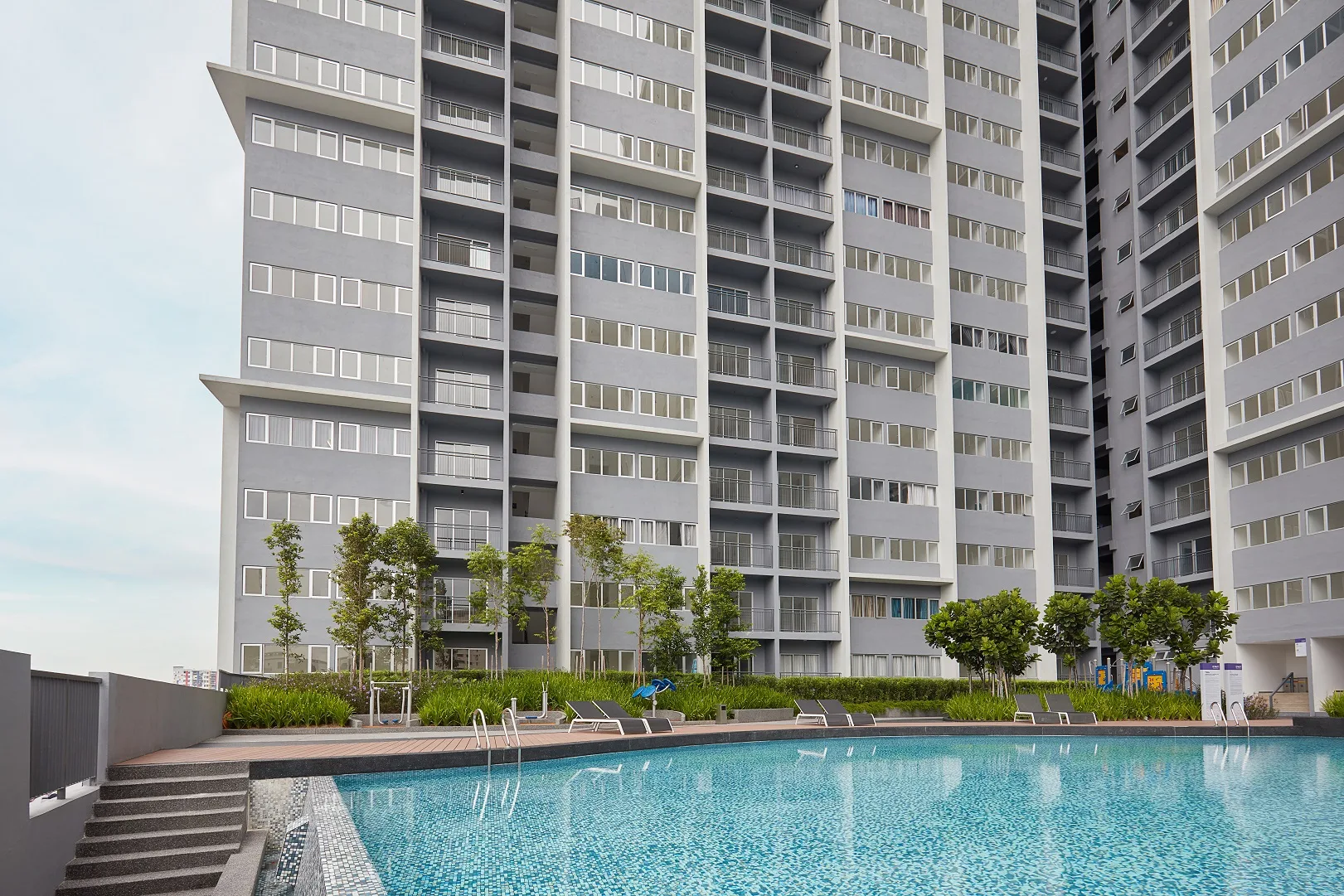
The government record splits the facilities across the ground floor, level 6 and level 41 — guardhouse, playground and main lobby at street level; swimming pool, a fully equipped gym and a children’s play room on level 6; multipurpose hall and surau on level 41. EXSIM’s own sentence adds a wading pool and calls the level 41 space a sky multipurpose hall. The level 6 podium placement matters more than it sounds. A pool deck on the sixth floor of a 44-storey tower is overlooked by thirty-eight floors of apartments, which affects privacy, noise complaints and how the management schedules pool hours. Go and look at it at 6pm on a Saturday before you decide.
The public record and the listing sites do not agree
Three specific disagreements, all worth knowing. Storeys: the Federal Territories Department describes the approved scheme as 557 units over 44 floors; portals report 42. Completion: portals say the building was completed around 2017, but the government record gives an expected completion of 25 June 2020 and EXSIM’s own site progress photographs continue into the third quarter of 2020. The 2017 date on portals matches the publication date of EXSIM’s project page, which is almost certainly where it came from. Layout: a competitor listing describes 550 sq ft two-bedroom units; both official sources say 850 sq ft, three bedrooms, two bathrooms. Where a portal and a government register disagree, I use the register and tell you about the gap.
The whole development, decoded
One tower, one layout, 557 times over. That is unusual enough to be worth pausing on. Every apartment in this building is 850 sq ft with three bedrooms and two bathrooms — there is no studio, no dual key, no penthouse and no corner premium in the mix. For a buyer that has one very concrete consequence: when you go to sell or let, you are competing against 556 identical units, and the only variables left are floor level, orientation, renovation and how well the previous owner looked after it.
One building, described two different ways
The government record
The Residensi Wilayah project record is the most complete public description of this building that exists. It gives the scheme description verbatim: a proposed apartment of 557 units over 44 floors on Lot PT15622, Jalan 2/125, Desa Petaling, Mukim Petaling, in the district of Kuala Lumpur. It names the developer as Aspire Causeway Sdn Bhd, gives the developer’s registered address and contact numbers, lists a single residential option at 850 kaki persegi and RM300,000, sets out the facilities floor by floor, names Plaza Salak Park as the landmark, prints a coordinate, and states an expected completion of 25 June 2020. It also records the application window and shows it closed. Nothing on any listing site comes close to that level of detail, and none of it is marketing copy.
The developer’s own pages
EXSIM publishes three pages for this project and they are visual rather than numerical. The concept page carries four renders and one paragraph: entry price from RM300,000, designed for urban families, facilities including a swimming pool, wading pool, children’s playground, gym and sky multipurpose hall, set in the mature neighbourhood of Desa Petaling. The gallery page carries thirteen photographs of the finished building, twenty show-unit interiors and three artist’s impressions. The site progress page carries an unbroken quarterly photographic series from the second quarter of 2017 through to the third quarter of 2020. What none of the three pages carries is a unit count, a storey count, a tenure statement, a licence number or a completion date.
The listing sites
Listing databases are useful for asking prices and useless for specifications. On this building they report 42 storeys against the register’s 44, a completion year of 2017 against a registered expected completion of 25 June 2020, and in one competitor’s case a 550 sq ft two-bedroom layout that appears in no official source at all. The mechanism is not fraud, it is copying: one database populates a field, another scrapes it, an agent quotes the second, and five years later the wrong number is everywhere and nobody remembers where it started. I have used listing sites on this page for exactly one thing — to know what buyers are being told — and for nothing else.
The facilities, level by level, from the government record
The Federal Territories Department record sets out the facilities by floor, which is more precise than the developer’s own marketing sentence. Where the two disagree — and they do, in one place — I have shown both. Nothing below is inferred from photographs.
As set out on the government record, floor by floor
- Ground floor — security guardhouse, children’s playground, main lobby
- Level 6 — swimming pool
- Level 6 — fully equipped gymnasium
- Level 6 — children’s play room
- Level 41 — multipurpose hall
- Level 41 — surau
What EXSIM adds in its own wording
- Wading pool — named by the developer, not on the government list
- Sky multipurpose hall — the developer’s name for the level 41 space
- Swimming pool, children’s playground and gym — both sources agree
- The phrase and more, which I have not tried to fill in
Not published, therefore not on this page
- Tenure — freehold or leasehold, and the balance of term
- Monthly maintenance charge and sinking fund contribution
- Car park allocation per unit
- Strata title issuance status
- Developer licence and advertising permit numbers
- Certificate of completion and compliance date
Where the project is now
The D’Nuri Residences @ Desa Petaling floor plan
There is exactly one. The government record lists a single residential option, Type A, 850 kaki persegi, RM300,000, three bedrooms and two bathrooms. No second type, no size band, no unit mix table. A competitor listing describes this building as 550 sq ft with two bedrooms; that figure does not appear in any official source I can find and I have not used it.
Type A — 850 sq ft, and there is no Type B
Get this floor planInside D’Nuri Residences @ Desa Petaling


Where D’Nuri Residences @ Desa Petaling sits
The address on the government register is Lot PT15622, Jalan 2/125, Desa Petaling, Mukim Petaling, Daerah Kuala Lumpur, 57100 Wilayah Persekutuan Kuala Lumpur. That last phrase is the one that decides everything else on this page. Desa Petaling is not in Selangor. It is inside the Federal Territory of Kuala Lumpur, which runs a different foreign-ownership rulebook, a different approving committee and a different price threshold from the state that surrounds it on three sides.
The coordinate on this map, 3.0848, 101.6989, is not mine and not a portal’s. It is the coordinate printed on the Federal Territories Department’s own Residensi Wilayah project record for this development, alongside the lot number. That is about as authoritative as a pin gets in Malaysia.
- Plaza Salak Parknamed, not measuredthe only landmark on the government record
- Registered coordinate of the development3.0848, 101.6989printed on the Federal Territories Department record
- Kuala Lumpur city boundaryinside itMukim Petaling, Daerah Kuala Lumpur — a Federal Territory address
- Nearest rail stationnot publishedneither the developer nor the government names one
- Schools, hospitals and mallsnot publishedthe developer says amenities are nearby and lists none
- Real weekday drive timesask meI would rather drive it than quote a number I cannot source
The statutory name is Pangsapuri Nuri Desa Petaling — and every unit was permitted at one price
| Project code | Registered name | Licensed developer | Advertising permit | Units | Built-up | Price band on the permit | Built | Status |
|---|---|---|---|---|---|---|---|---|
| 14336-2 | Pangsapuri Nuri Desa Petaling | Aspire Causeway Sdn Bhd (14336) | 14336-2/02-2021/01287(P) | 557 | 80 sq m (about 861 sq ft) | RM300,000 flat | 100% | Siap Dengan CCC |
Swipe sideways to see the full table →
Read from teduh.kpkt.gov.my on 27 August 2026. Pull it yourself: teduh.kpkt.gov.my/semakan-status-kemajuan?kodProjek=14336-2
Two fields agree exactly
The licensed company on this page is Aspire Causeway Sdn Bhd, which holds this licence, and 557 units is exactly the figure at the top of this page. The registered name also carries both “Nuri” and “Desa Petaling” verbatim.
A single permitted price of RM300,000 — this is the most important line here
The permit records a minimum and a maximum that are the same number: RM300,000. A flat ceiling across all 557 units at 861 sq ft is the signature of a price-controlled affordable scheme — in Kuala Lumpur, typically RUMAWIP or a comparable programme.
That changes what you are buying in ways a brochure would not lead with. Price-controlled schemes normally carry a moratorium on resale (commonly ten years), an eligibility test on the buyer, income and ownership conditions, and a requirement to sell back or to sell only to another eligible buyer. They are also generally not available to foreign buyers at all, regardless of price.
This is not a criticism of the development. It is a category, and the category determines your exit. Before you commit, ask in writing: which programme is this unit under, what is the moratorium period, what are the eligibility conditions, and what are the resale rules. Ask your solicitor to confirm the restriction is endorsed on the title, because a private-treaty resale of a restricted unit can be void.
Completed with a CCC
Siap Dengan CCC means the Certificate of Completion and Compliance has been issued and construction is recorded at 100%.
About Aspire Causeway Sdn Bhd (EXSIM Group)

The company named on the government record is Aspire Causeway Sdn Bhd, with a registered address at No 7-G, Medan Klang Lama 28, No. 419, Jalan Klang Lama, 58000 Kuala Lumpur. Property portals list the developer as EXSIM Development Sdn Bhd. Both descriptions point at the same group — the contact email printed on the Federal Territories Department record for this project ends in exsim.my, and EXSIM’s own website carries D’Nuri Residences under its developments — but the legal entity that held the licence and signed the sale and purchase agreements is Aspire Causeway. If you are buying a unit in the subsale market, the name on your predecessor’s original agreement is the one that matters when your solicitor traces title, so use the register name, not the brand name.
EXSIM is better known today for its city-centre high-rise portfolio, and this site has separate pages for several of its Johor Bahru projects. D’Nuri sits at the opposite end of the same group’s range: a capped-price affordable scheme, one layout, one tower, delivered under a government programme rather than to an open market. That is worth understanding rather than glossing over, because it explains almost every design decision here — a single repeated floor plate, a facilities list of eight items rather than thirty, and a specification written to a price ceiling.
What the group actually published, and when. The project page went up on 13 April 2017 and carries three artist’s impressions whose filenames contain the letters rmm, the standard Malaysian abbreviation for rumah mampu milik, affordable housing. The gallery holds twenty show-unit photographs and thirteen photographs of the completed building. The site progress page runs an unbroken quarterly series from the second quarter of 2017 to the third quarter of 2020 — fourteen quarters, roughly thirty-five photographs. That is a more complete public construction record than most launches on this site have, and it is the single best reason to trust the delivery timeline over the second-hand versions circulating elsewhere.
What the group did not publish. There is no tenure statement anywhere on EXSIM’s pages for this project, no storey count, no unit count, no completion date, no developer licence number and no advertising permit number. Every one of those blanks is filled on this page only where the Federal Territories Department filled it, and left empty where nobody did. On a completed building bought in the subsale market that is less dangerous than on a new launch, because your solicitor will pull the actual title — but it does mean you should ask for the title search early rather than assume.


Frequently asked questions
Can a foreigner or a Singaporean buy at D’Nuri Residences @ Desa Petaling?
No. Two separate rules block it, and neither has an exception that applies here.
The first is the Federal Territory threshold. Desa Petaling is in Mukim Petaling, Daerah Kuala Lumpur — inside the Federal Territory of Kuala Lumpur, not in Selangor. Kuala Lumpur sets a minimum purchase price of RM1,000,000 for a non-citizen acquiring residential property, and the consent application goes to the Jawatankuasa Kerja Tanah Wilayah Persekutuan Kuala Lumpur under section 433B of the National Land Code. That is the Land Working Committee — not an executive committee, and not the federal economic planning unit that older guides still name. Units in this building were sold new at RM300,000.
The second is the programme itself. This is a Residensi Wilayah scheme. The published eligibility criteria require the applicant to be a Malaysian citizen aged at least 21 who was born in, works in, or resides in the Federal Territories, with gross household income not exceeding RM10,000 a month for a single applicant or RM15,000 for a married couple. A foreign passport does not satisfy the first line of that test.
One point that catches people out: in Malaysian land law the expression foreign interest includes Malaysian permanent residents. Holding PR does not put you on the citizen side of either rule.
If a foreign buyer is being offered a unit here through a nominee or a company structure, treat that as a warning rather than an opportunity. It will surface on a title search, and the consequences fall on the buyer.
If your budget is around this level and you want something a foreign buyer can legally hold, the constraint is the RM1,000,000 Kuala Lumpur floor rather than the neighbourhood. Message me and I will send you what actually clears it.
I am a Malaysian citizen. Can I buy a unit here in the subsale market?
Possibly, but the ten-year moratorium is the gate and you need to check it on the title before anything else.
A Residensi Wilayah unit carries a restriction preventing sale or transfer for ten years without government consent. Transfers to immediate family — a spouse or children — are the stated exception. Renting the unit out to a Malaysian citizen tenant is permitted.
Work the dates. The government record gives an expected completion of 25 June 2020 and the developer’s last site progress photographs are from the third quarter of 2020. If the first owners took vacant possession in that window, the ten years run to roughly 2030. So an ordinary open-market resale today is either inside the moratorium and requires consent, or it is something you need explained to you in writing before you pay anything.
The practical sequence I would follow. Ask the seller for a copy of the individual or strata title and read the restriction-in-interest endorsement yourself. Ask when vacant possession was given, in writing. Ask whether an application for consent to transfer has been made and what its status is. Then take all three to a conveyancing solicitor before you sign a booking form, not after.
There is one more thing worth checking that nobody mentions: whether you personally would still satisfy the Residensi Wilayah eligibility criteria, because a consent application may be assessed against them. If your household income has risen past the ceiling since 2018, that is a question to ask early rather than discover late.
If all of that checks out, this is a perfectly ordinary 850 sq ft three-bedroom apartment in a mature Kuala Lumpur neighbourhood and the rest of the analysis is the normal one — floor, orientation, maintenance charge, sinking fund, and how the building has been looked after.
Is this building 42 storeys or 44?
The Federal Territories Department record says 44. Property portals say 42. I use 44 and I will tell you exactly why.
The government record does not describe the building in marketing language. It reproduces the approved scheme description: a proposed apartment of 557 units over 44 floors on Lot PT15622, Jalan 2/125, Desa Petaling, Mukim Petaling, in the district of Kuala Lumpur. That wording comes from the development approval, not from a brochure.
There is corroboration inside the same record. The facilities list places the multipurpose hall and the surau on level 41. A building with facilities on level 41 and nothing above them would be an odd shape; a building with residential floors continuing to 44 is ordinary.
It is also possible that both are true in a way. Malaysian towers frequently skip floor numbers considered inauspicious, so the highest number on the lift panel and the count of physical slabs are not always the same. That would explain a 42 against a 44 without anyone lying.
Does it matter to a buyer? Only in two ways. It changes what the top floor actually is, which matters if you are paying a premium for height. And it is a useful reminder that if the storey count on a listing is wrong, the maintenance charge, car park allocation and built-up on the same listing deserve the same scepticism.
If you are looking at a specific unit, the floor number on the strata title is the one that counts, and I will get it.
When was it actually completed? Portals say 2017.
Not 2017. The best-supported answer is the second half of 2020, and the 2017 figure has a traceable origin.
The government record states an expected completion of 25 June 2020. EXSIM’s own site progress page carries an unbroken quarterly photographic series running from the second quarter of 2017 to the third quarter of 2020 — fourteen quarters. A developer does not publish construction photographs of a building that was finished three years earlier.
So where does 2017 come from? EXSIM’s project page for this development is dated 13 April 2017. That is the date the page was published, at roughly the point the project was being marketed. Someone populating a database read a date on a developer page and put it in a completion field. Once it was in one database it spread.
This is a good example of why the source of a number matters more than how many places repeat it. Six listing sites carrying the same wrong year is not six confirmations, it is one error copied five times.
For a buyer today the practical consequence is small but real: a building handed over in 2020 is six years into its life, which is when the first significant common-property expenditure usually shows up — lift refurbishment, pump replacement, external repainting. Ask the management office for the sinking fund balance and the last three years of accounts. A building described as 2017 would be nine years in, and you would budget differently.
The date that binds anyone is the one on the certificate of completion and compliance. Ask for it.
Why does one listing describe 550 sq ft two-bedroom units?
Because that figure is not supported by any official source I can find, and I have not reproduced it on this page.
Both official sources agree with each other. The Federal Territories Department record lists a single residential option: Type A, 850 kaki persegi, at RM300,000, specified as three bedrooms and two bathrooms. EXSIM’s own concept page describes the development as purposefully designed for urban families, which fits an 850 sq ft three-bedroom product and does not fit a 550 sq ft two-bedroom one.
There is also an internal logic check. A Residensi Wilayah unit is capped at RM300,000. At 850 sq ft that is about RM353 per square foot; at 550 sq ft it would be about RM545 per square foot, which is not how a capped affordable scheme is priced. The 850 figure is the one that behaves like an affordable-housing number.
Why bother writing this down at all? Because built-up area is the denominator in every calculation you will make — price per square foot, rental yield, maintenance charge per square foot. Getting it wrong by 300 sq ft does not shade your numbers, it inverts them.
The rule I apply on this site is simple. If a figure is not from the developer, from a government source, or measured by me, it does not appear. When two sources disagree, I say so rather than quietly pick one and hope nobody checks.
For any specific unit, the built-up on the strata title is final. If you send me a listing I will check it against the title rather than against another listing.
What is the maintenance charge, and is there a car park?
Neither figure has been published by the developer or the government, so neither is on this page.
That is not evasion, it is the same rule I apply everywhere. The Federal Territories Department record covers the scheme, the price, the layout, the facilities and the location. It does not cover the service charge or the parking allocation, because those are matters for the deed of mutual covenants and the management corporation, not the housing programme.
What I can tell you is why it matters more here than in most buildings. A 557-unit tower with a pool, a gym, a children’s play room, a multipurpose hall and a surau across three levels has a real operating cost, and that cost is divided across units that were all sold at a capped RM300,000. Affordable schemes are structurally exposed to service charge arrears, because the households who qualify by income are the same households with the least slack in a bad year. A high arrears rate starves the sinking fund, and the sinking fund is what pays for the lifts.
So the three documents I would ask the management office for, in this order: the current service charge and sinking fund rate per square foot, the arrears percentage, and the audited accounts for the last three financial years. A building that will show you all three is usually a building that is being run properly.
On parking, the practical question is not only how many bays come with the unit but whether the bay is on the strata title or merely allocated. Those are different things when you sell.
Send me the unit you are looking at and I will collect all of it from the management office rather than from an agent’s memory.
Is Desa Petaling in Kuala Lumpur or Selangor, and why does it matter?
Kuala Lumpur. The government record is explicit: Mukim Petaling, Daerah Kuala Lumpur, Wilayah Persekutuan Kuala Lumpur, postcode 57100.
It is a fair question to ask, because Desa Petaling sits close to the southern edge of the Federal Territory and the name looks like it belongs to Petaling Jaya, which is in Selangor. It does not. Mukim Petaling in Kuala Lumpur and the Petaling district in Selangor are two different administrative units that happen to share a name.
It matters because the two jurisdictions run different rulebooks for foreign buyers, and the difference is large. In Kuala Lumpur the minimum purchase price for a non-citizen is RM1,000,000 and consent goes to the Jawatankuasa Kerja Tanah Wilayah Persekutuan Kuala Lumpur under section 433B of the National Land Code. In Selangor the guidelines are zoned, with a RM2,000,000 minimum across the districts of Petaling, Gombak, Hulu Langat, Sepang, Klang, Kuala Selangor and Kuala Langat, consent goes to the state land office, and non-citizens are restricted to strata and landed-strata property.
So the same building moved a few kilometres south would face a threshold twice as high and a different consent authority. Neither helps here, because this project is a citizens-only scheme priced at RM300,000, but the distinction is worth carrying with you if you are comparing across the Klang Valley.
One more federal rule applies wherever you buy. From 1 January 2026 a flat 8% stamp duty rate applies to non-citizens acquiring residential property, and the legislation names serviced apartments and SOHO units specifically. Real property gains tax for a non-citizen is 30% within the first five years and 10% from the sixth year onwards, with no zero band however long you hold.
Thresholds and state circulars get revised. Have a Malaysian conveyancing solicitor confirm the current position for your specific case before you commit to anything.
How does the Kuala Lumpur market look for a building like this in 2026?
Soft at the top, and this building is not at the top. That distinction is the whole answer.
The national valuation department’s figures for Kuala Lumpur in the first quarter of 2026 show 3,733 unsold completed residential units and 4,181 unsold completed serviced apartments. Those are large numbers, and they explain why so much agent marketing in the city sounds anxious.
But read where that overhang sits. It is concentrated in high-rise stock aimed at investors — small units, high floors, city-fringe addresses, priced well above what a household earning under RM15,000 a month can service. An 850 sq ft three-bedroom apartment sold at RM300,000 under a citizens-only programme is not competing in that market at all. Its buyer pool is defined by an income ceiling, not by investor sentiment, and its supply is fixed at 557 units with no phase two coming.
That cuts both ways and I want to be straight about the unpleasant half. The moratorium that protects the programme also caps your liquidity: for ten years you cannot sell freely, and after that your buyer must generally still qualify. A restricted asset trades at a discount to an unrestricted one. In exchange you got the unit at a capped price in the first place.
The rental side is the more interesting half. Letting to a Malaysian citizen tenant is permitted, three-bedroom stock at this size and price point is thin in the Federal Territory, and demand from families rather than from single professionals tends to be stickier through a downturn.
Those valuation figures are quarterly and will move. Ask me for the current quarter before you use any of them in a decision.
What should I actually do next if I want a unit here?
Five steps, in this order, and the first two cost nothing.
One. Confirm your own eligibility. Malaysian citizen, at least 21, born in or working in or resident in the Federal Territories, household income within the published ceilings. If any of those fails, stop here and let me show you something you can actually own.
Two. Get the seller to produce the title. Not the sale and purchase agreement, not the assessment bill — the individual or strata title, so you can read the restriction-in-interest endorsement and the date of issue. This is the single document that determines whether the transaction is possible at all.
Three. Establish the vacant possession date in writing and count ten years from it. If you land inside the moratorium, the transaction needs government consent and your solicitor needs to structure the agreement around that, with a proper mechanism if consent is refused.
Four. Get the building’s numbers from the management office: service charge and sinking fund per square foot, arrears percentage, audited accounts for three years, and the status of strata title issuance. A six-year-old 557-unit tower is at the age where these tell you a great deal.
Five. Then, and only then, look at the unit. Floor level, orientation, which way the living room faces relative to the level 6 pool deck, and the condition of the common corridors on that floor rather than just inside the apartment.
Message me and I will do steps two, four and part of three for you before you spend a Saturday on viewings.
Before you look at a listing here, check whether you can legally own it
Most enquiries about this building end in one of two places: the buyer is not a Malaysian citizen and the answer is a flat no, or the buyer is a citizen and the real question is whether the seller has cleared the ten-year moratorium and obtained consent. I will check which of those you are in five minutes, for free, before either of us spends any more time on it.
Subsale transactions carry an agent fee; I will tell you the number before you engage me
Louis Koh
11 years in Malaysian property · Johor Bahru & Kuala Lumpur new launches · English & 中文
I work with cross-border buyers from Singapore and with local investors. I'll tell you when a project isn't right for you — that's usually worth more than the brochure.
Published 2026-08-11 · Last verified 2026-08-11 against Aspire Causeway Sdn Bhd (EXSIM Group)'s published project material. Unit availability, pricing and completion dates are set by the developer and subject to change. This page is marketing information, not an offer or a contract.
Ask a specific question
If you would rather not use WhatsApp, use this. I answer them myself. Only your name and one contact method are required.
Developer: EXSIM Group (19 developments on this site)
Where it is: Desa Petaling, Kuala Lumpur (KL)
The unit mix, the permitted price and how far up it is
None of this table is the developer’s account of itself. It is what the Ministry of Housing and Local Government records from the 7(f) returns: unit type, bedrooms and bathrooms, built-up area, unit count, the price range on the permit, and the certified percentage complete. A brochure price can be revised; the price on the permit was filed. A brochure need not mention progress; the percentage is certified. The status vocabulary is theirs too: Lancar (on schedule), Lewat (behind), Sakit (sick), Terbengkalai (abandoned).
14336-2 · PANGSAPURI NURI DESA PETALING
Overall status: Siap Dengan CCC — completed
| Component | Bed / bath | Built-up | Units | Price on the permit | Complete |
|---|---|---|---|---|---|
| Rumah Pangsa/Kondo 44 storeys Siap Dengan CCC | — | 80 m² ≈ 861 sq ft | 557 | RM300,000.00 | 100.00% |
Swipe the table sideways for the rest of the columns.
Read from teduh.kpkt.gov.my on 2026-10-17, project code 14336-2. Re-read weekly.
What to do with the number. Read it against the delivery date in your own agreement, not against what a salesperson says. A project with a year left on its statutory clock and a third of the building up is telling you something the brochure will not.
How does that compare? Every development on this site, grouped by register status — cancelled, abandoned and behind schedule first.