Setia Edge @ Setia Business Park II
Freehold factory lots inside a gated business park, priced from RM3.39 million — 10 kN/m² floor loading, 150-amp three-phase power, and no foreign-ownership quota on industrial title in Johor.
⚡ Typical reply within 15 minutes, 9am–10pm MYT · No obligation

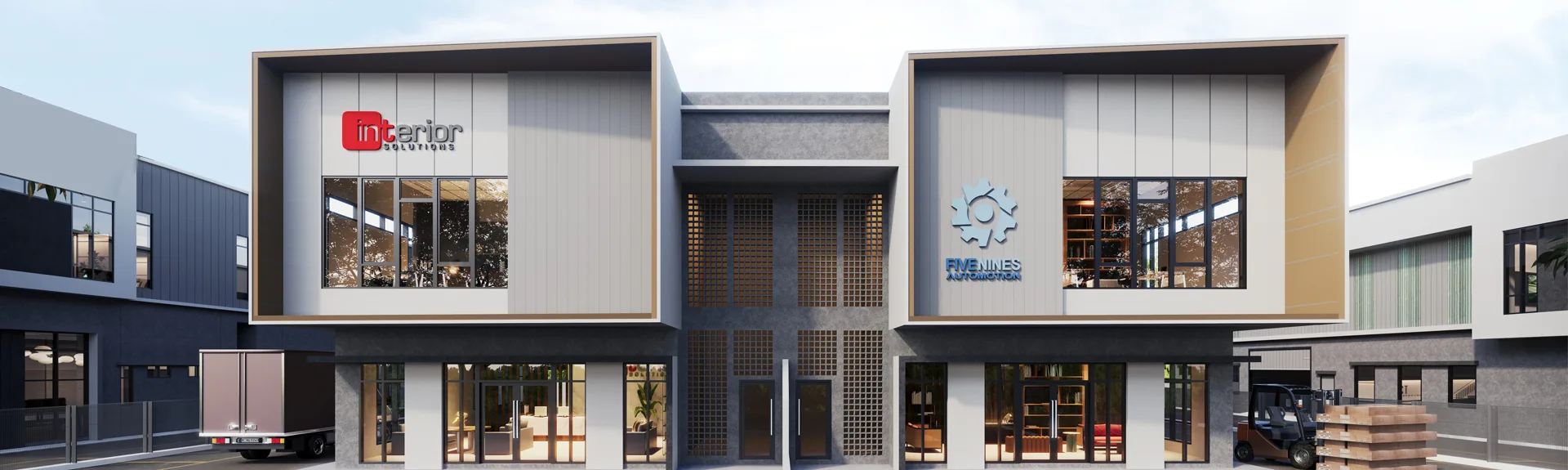
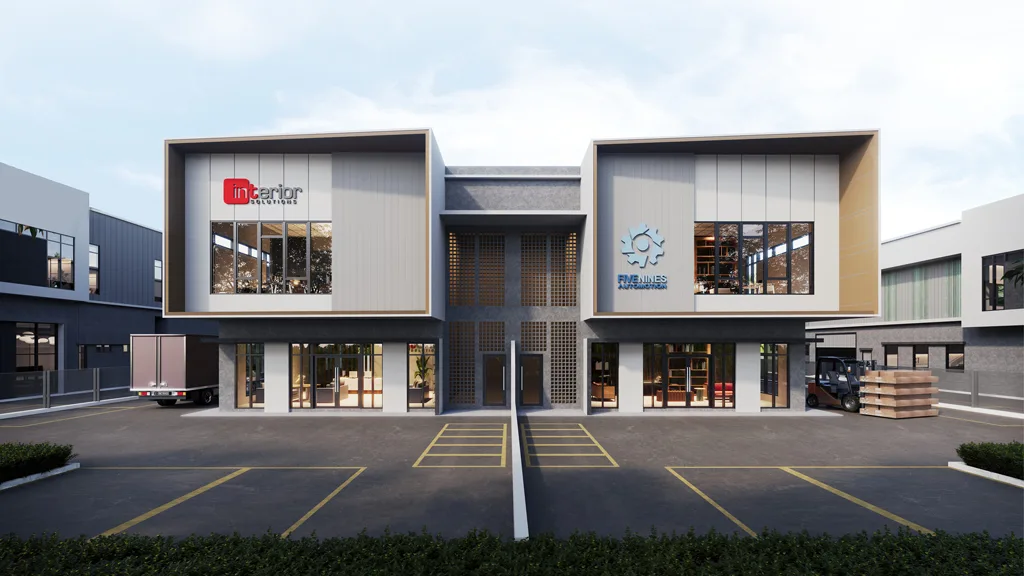
Setia Edge @ Setia Business Park II at a glance
Everything below is either printed on S P Setia’s own Setia Edge page or taken from a government source I can name. Where the developer has not published a number, this page does not invent one — and Setia Edge has more blanks than most launches, so I have listed them explicitly further down rather than filling them with portal guesses.
- Development
- Setia Edge @ Setia Business Park IIFinal phase · S P Setia Berhad (19698-X)
- Product
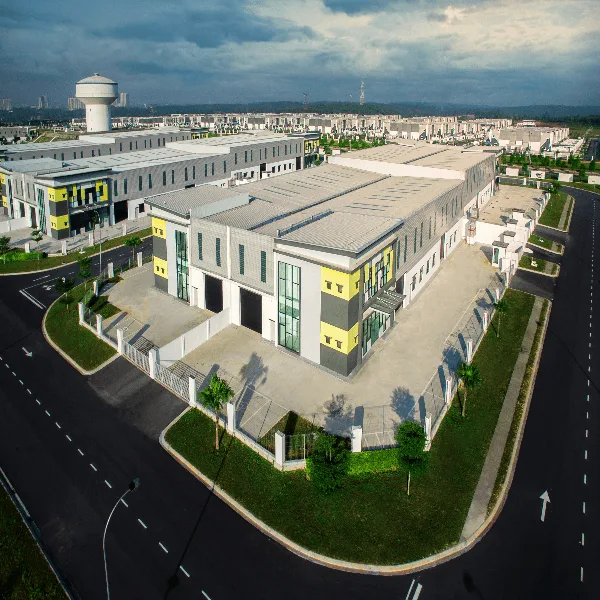
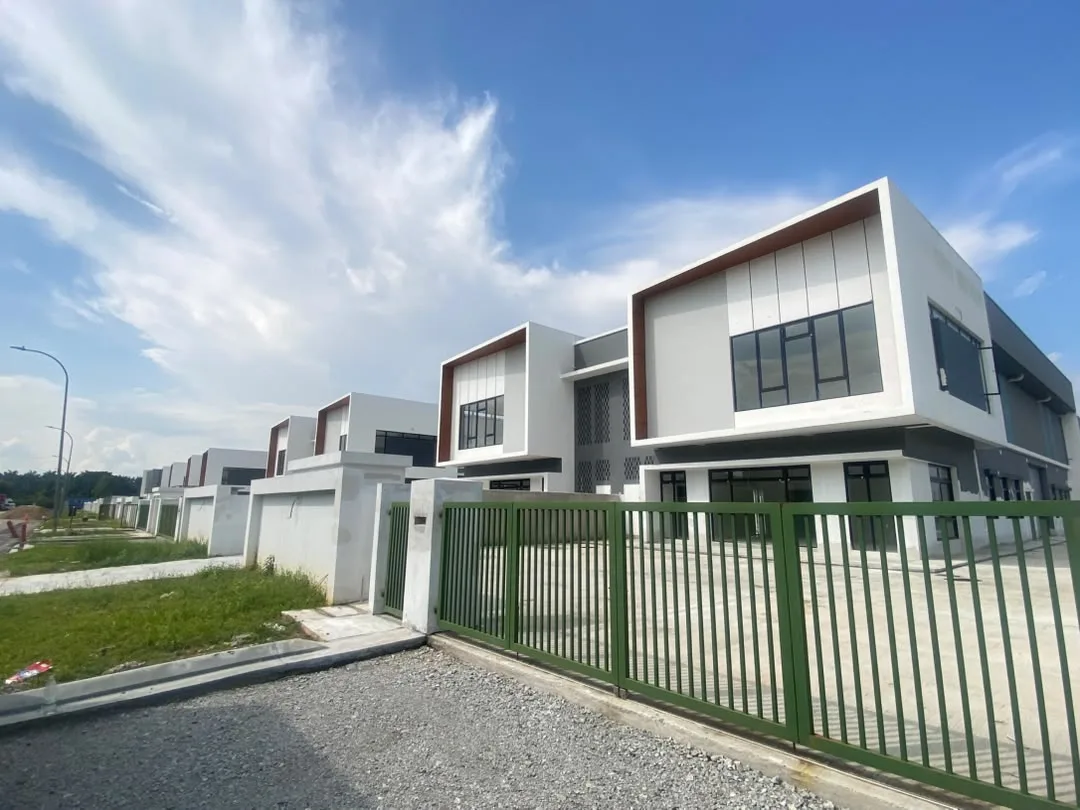
- Two-storey factories, medium industrialCluster, link-bungalow and detached
- Land area per lot
- 8,681 – 14,727 sq ftDeveloper’s published range
- Built-up
- 5,158 – 5,414 sq ftAcross the three variants
- Entry price
- From RM3.39 millionS P Setia’s own corporate property record
- Floor loading
- 10 kN/m² production floorSame rating for the concrete driveway
- Power supply
- 3-phase, 150 amp, 415 VFibre termination box provided per unit
- Tenure
- FreeholdDeveloper marketing; no statutory strip for this phase
- Land use
- Industrial titleNot residential — see the tax and loan section
- Local authority
- MBJB, Mukim TebrauApproval reference MBJB/U/2014/14/BGN/46(45)
- Foreign buyers
- Allowed, no ownership quotaRM1m floor cleared · 4% Johor levy on industrial
- Status
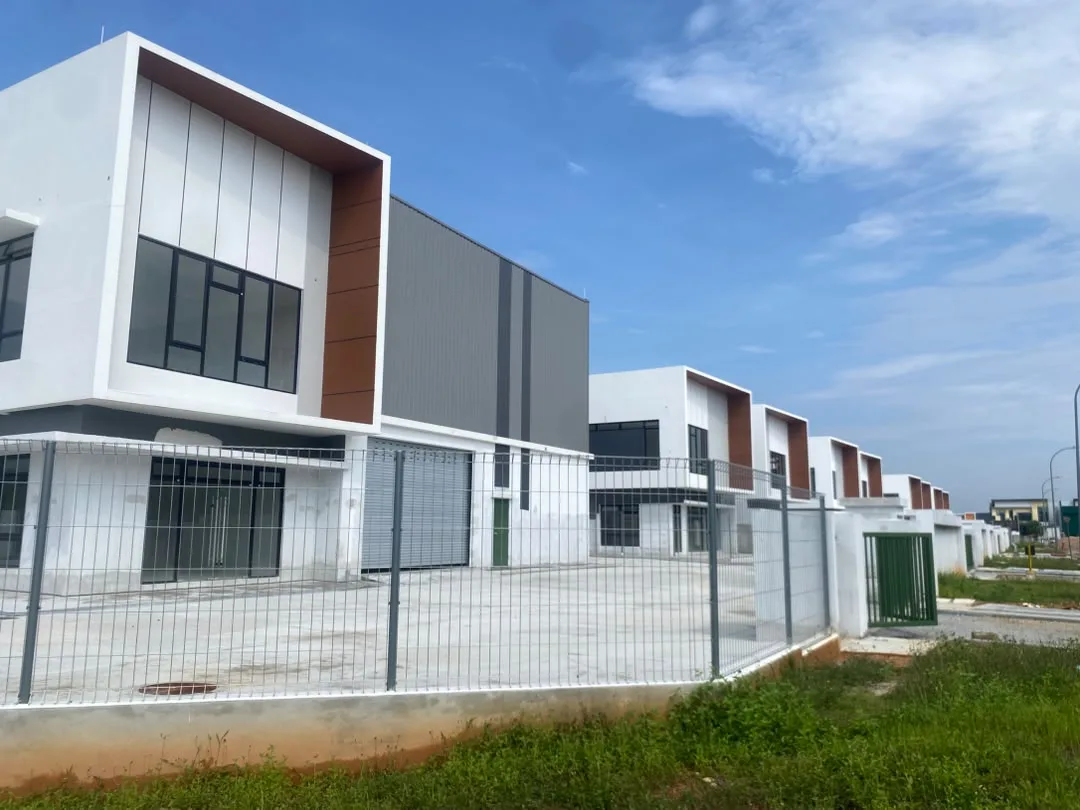
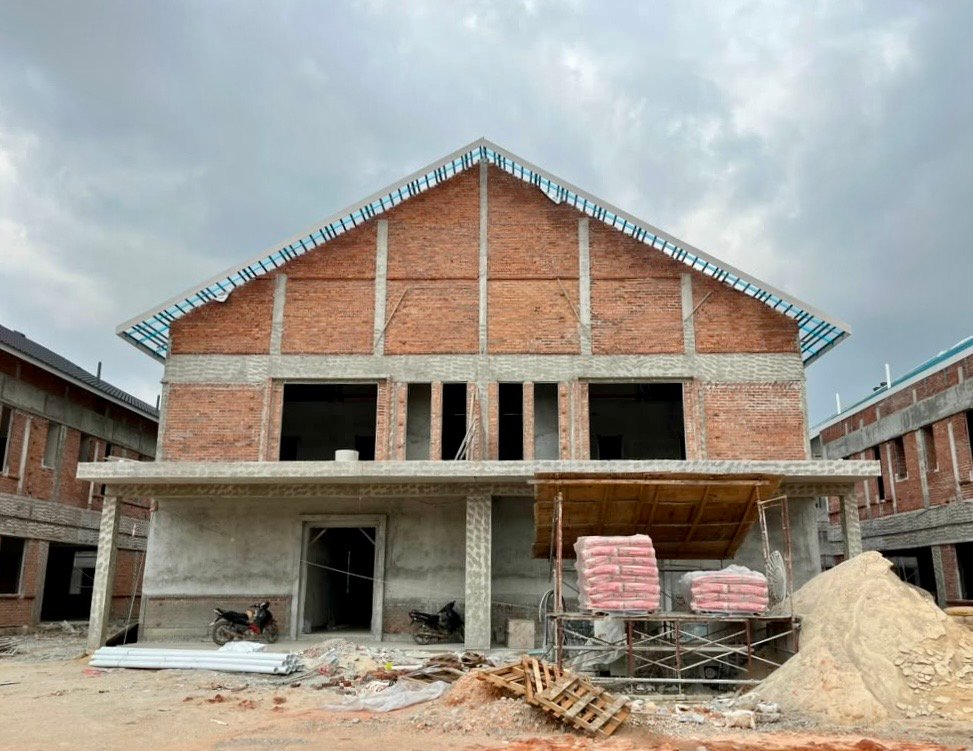
- Infrastructure in progressDeveloper site photos dated 7 July 2026
Explore related topics
Curated hubs, each with its own guide — not auto-generated tag archives.
Six reasons an industrial buyer looks at Setia Edge
This is not a home. Nobody buys here for a view. The case for Setia Edge rests on title, load, power, road access and who your neighbours are.
Freehold industrial land, which is genuinely scarce
Most Johor industrial estates sit on leasehold land, often 60-year terms with a state consent hurdle on every transfer. S P Setia’s own channels describe Setia Edge as freehold, and the statutory disclosures for the residential phases inside the same park state Hak Milik Kekal. I would still have your solicitor pull the title before the deposit — the industrial phase carries no statutory disclosure strip, because industrial products sit outside the Housing Development Act.
10 kN/m² floor loading is published, not implied
S P Setia states 10 kN/m² for the production area and the concrete driveway. That is a real number you can hand to a machinery supplier. Plenty of shop-factory marketing skips floor loading entirely, and a buyer only discovers the problem when the crane arrives. What is not published is the clear ceiling height or the roller shutter dimensions — those two you must extract in writing.
150-amp three-phase supply as standard
Three phase, 150 amp, 415 V per unit, with lighting and 13A points counted out per variant in the developer’s spec table, plus a fibre termination box and fibre wall socket. For light manufacturing, assembly, food processing or a logistics operation with cold storage, 150 amp is a workable starting point. Heavier loads will need a TNB upgrade application — S P Setia does not publish whether the incoming infrastructure supports one, and that is a question to ask before you commit.
Gated, guarded, single entry and exit
One way in, one way out, with 24-hour guard monitoring. For a business holding stock, that layout matters more than the number of guards, because it makes vehicle logging meaningful. S P Setia has not published who manages the estate, what the management charge is, or whether there is CCTV and perimeter fencing — so treat the security claim as a design intent until the management contract is in front of you.
Four kilometres from the North-South Expressway
The nearest practical interchange is Exit 255C Bandar Dato’ Onn on the E2, about 4.7 km in a straight line, with Exit 255B Setia Tropika and Exit 255 Kempas a similar distance. Senai International Airport is 9.4 km straight line. The Senai-Desaru Expressway passes about 3.9 km north but has no interchange on that stretch, so do not assume it is a five-minute access — it is not.
Johor industrial is the one segment with no overhang
NAPIC’s Property Market Report for full-year 2025 puts Johor’s unsold completed industrial stock at 89 units, against 1,146 unsold completed shops and 3,705 unsold residential units. Johor industrial transaction value rose 44.0% year on year to RM9.57 billion. Whatever you have read about a Johor property glut, it is a residential and shop-lot story, not an industrial one.
The whole development, decoded
Specifications here are S P Setia’s own. The distances are mine — the developer publishes no distance table for this park, so I calculated them from the site coordinate rather than repeat a marketing figure I cannot source.
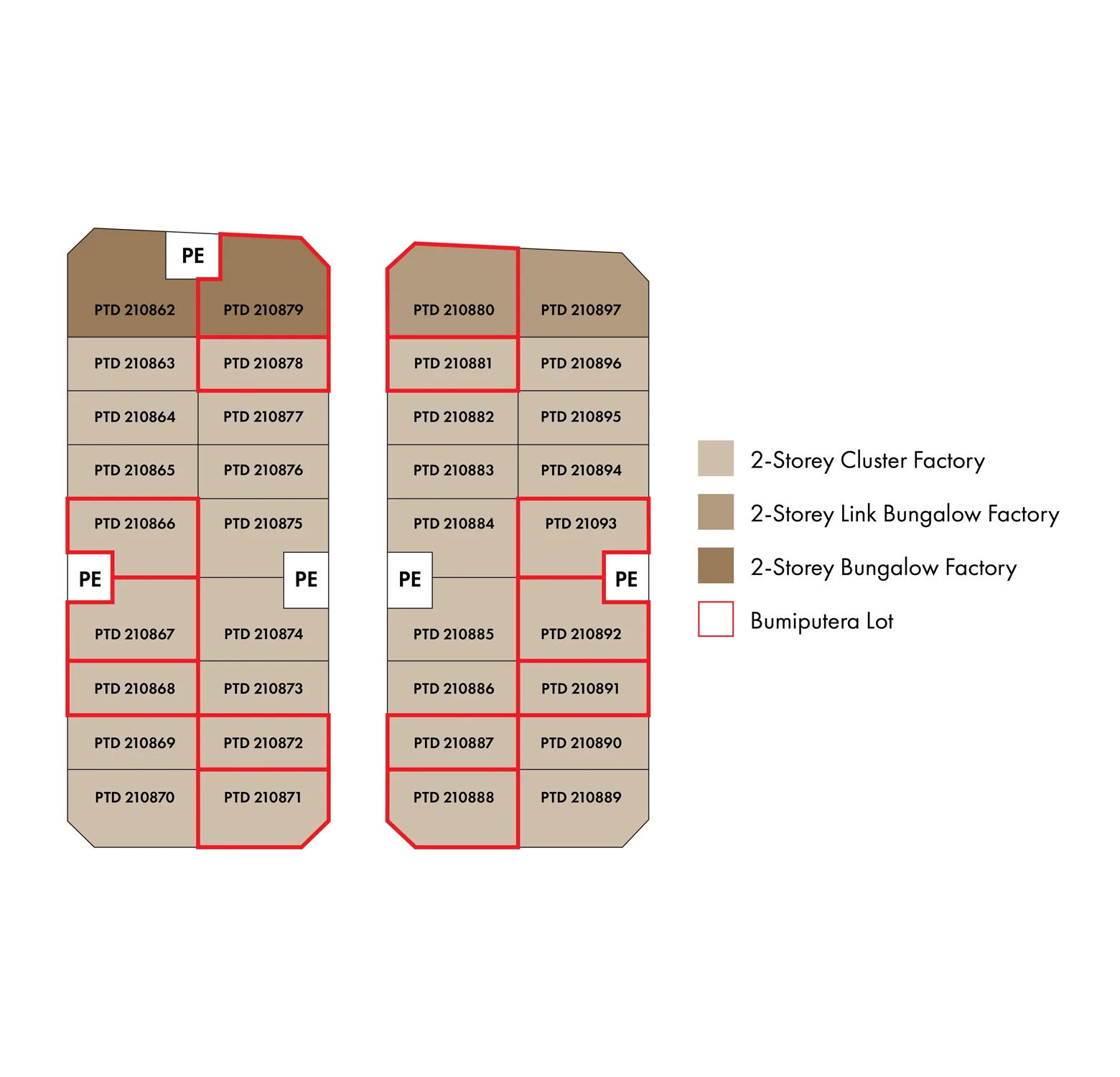
Three factory types, and how to choose between them
Cluster Factory
The entry point into the park. Land of 8,681 to 12,085 sq ft with 5,216 sq ft of built-up — the highest built-up-to-land ratio of the three, which is what you want if your operation is mostly indoors and you do not need a large yard. The spec table counts 32 lighting points, 13 thirteen-amp points, 3 exhaust fans, 14 emergency lights and 4 WCs. Suited to light assembly, workshops and trading operations that need warehouse plus a front office rather than a large loading apron.
Link Bungalow Factory
Land of 13,199 to 14,168 sq ft with 5,414 sq ft of built-up — the largest built-up figure S P Setia publishes for Setia Edge, on a lot roughly half as big again as the cluster type. The extra land is yard, and yard is what determines whether a 40-foot container can turn on your own site instead of blocking the estate road. If your business runs container deliveries rather than lorry deliveries, this is the variant to look at first.
Bungalow Factory (detached)
Fully detached, on 14,314 to 14,727 sq ft of land with 5,158 to 5,380 sq ft of built-up. Note that the built-up is slightly smaller than the link bungalow — you are paying for land and for four-sided access, not for floor area. Four-sided access matters if you need side loading, an external plant compound, a transformer or a genset. The spec table counts 5 WCs here versus 4 on the cluster type.
What is actually specified, and what is not
The left column is the developer’s published specification. The right column is what a factory buyer normally asks for and S P Setia has not published — ask for it in writing before you sign.
Published by S P Setia
- Gated and guarded park with a single entry and exit concept
- 24-hour security guard monitoring system
- Floor loading 10 kN/m² — production area and concrete driveway
- Electrical supply 3 phase, 150 amp, 415 V
- Reinforced concrete framework, steel frame and steel trusses
- Metal deck roofing or reinforced concrete flat roof
- Hardener floor finish to production and office areas
- Roller shutter, fire-rated door, plywood flush, PVC flush and glass door schedule
- Fibre termination box and fibre wall socket to each unit
- Eco-friendly north-south building orientation with a passive low-energy facade
- Point counts published per variant: lighting 32/35/38/42, 13A power 13/14/17/16
- Emergency lights 13-14, Keluar signs 6-7, bib taps 7, wash basins 3
NOT published — ask in writing
- Clear ceiling height of the production hall — nowhere on the developer’s site
- Roller shutter dimensions — door type is listed, size is not
- kVA capacity and whether the incoming infrastructure supports a TNB upgrade
- Loading bay detail and whether a 40-foot container can turn within the lot
- Internal estate road width and turning radius
- Car park bays allocated per unit
- Water and sewerage capacity — relevant for food and wet processes
- Total number of units in Setia Edge — the developer has never published one
- Expected completion and vacant possession date — also unpublished
- Estate management charge, managing agent, CCTV and perimeter fencing
- Total acreage and GDV of Setia Business Park II
- Whether the industrial titles carry a restriction-in-interest requiring state consent
Where the project is now
All 3 Setia Edge @ Setia Business Park II floor plans
Three layouts, all two storeys with an office block at the front and a production hall behind. Note the developer’s own page names them two different ways — “Cluster / Link-Bungalow / Bungalow” in the marketing copy and “Cluster & Semi-D / Bungalow Type A & B” in the specification table on the same page. I use the marketing names below and flag the discrepancy so you can ask which one appears on the SPA.
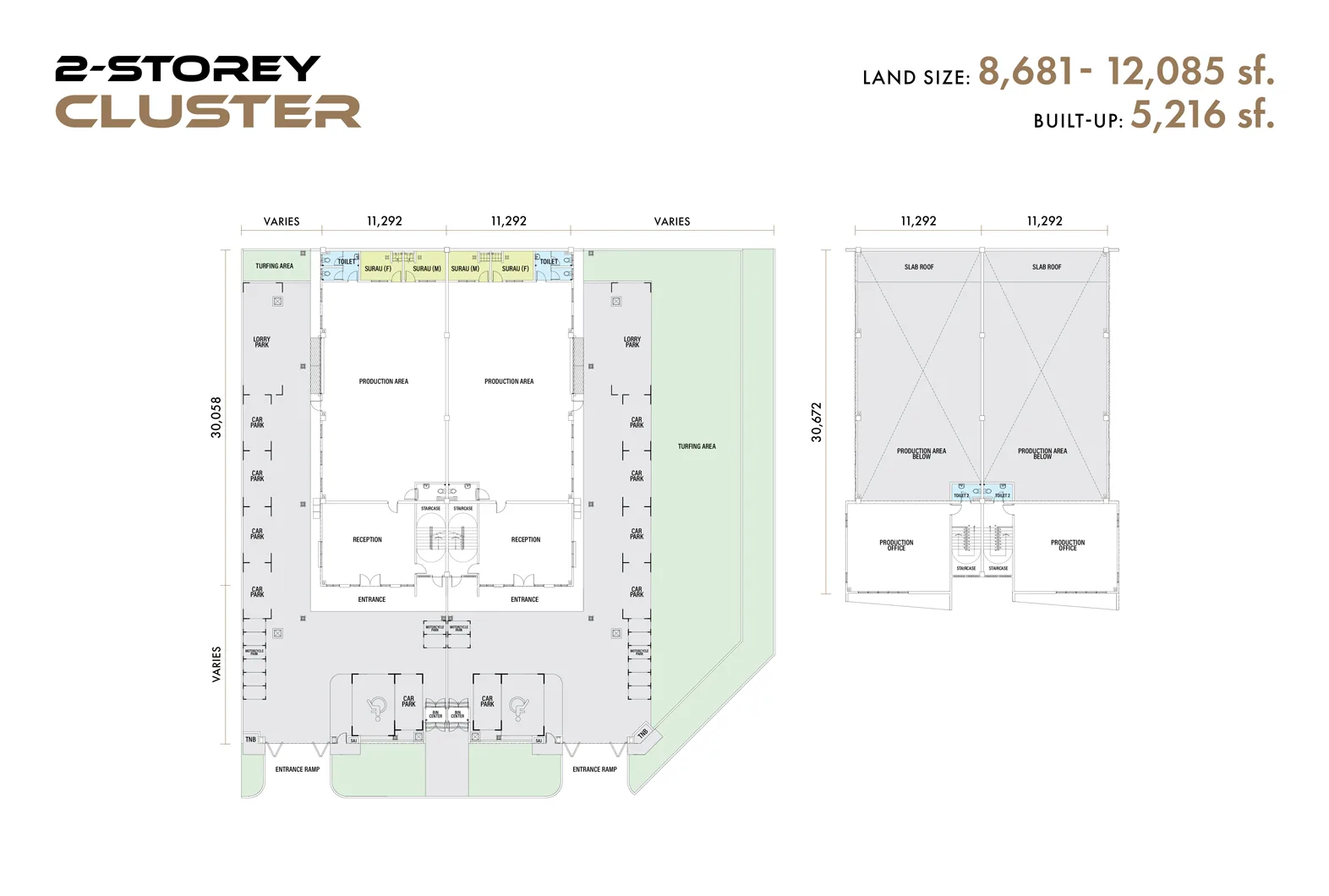
Cluster Factory — 5,216 sq ft built-up
Get this floor plan
Link Bungalow Factory — 5,414 sq ft built-up
Get this floor plan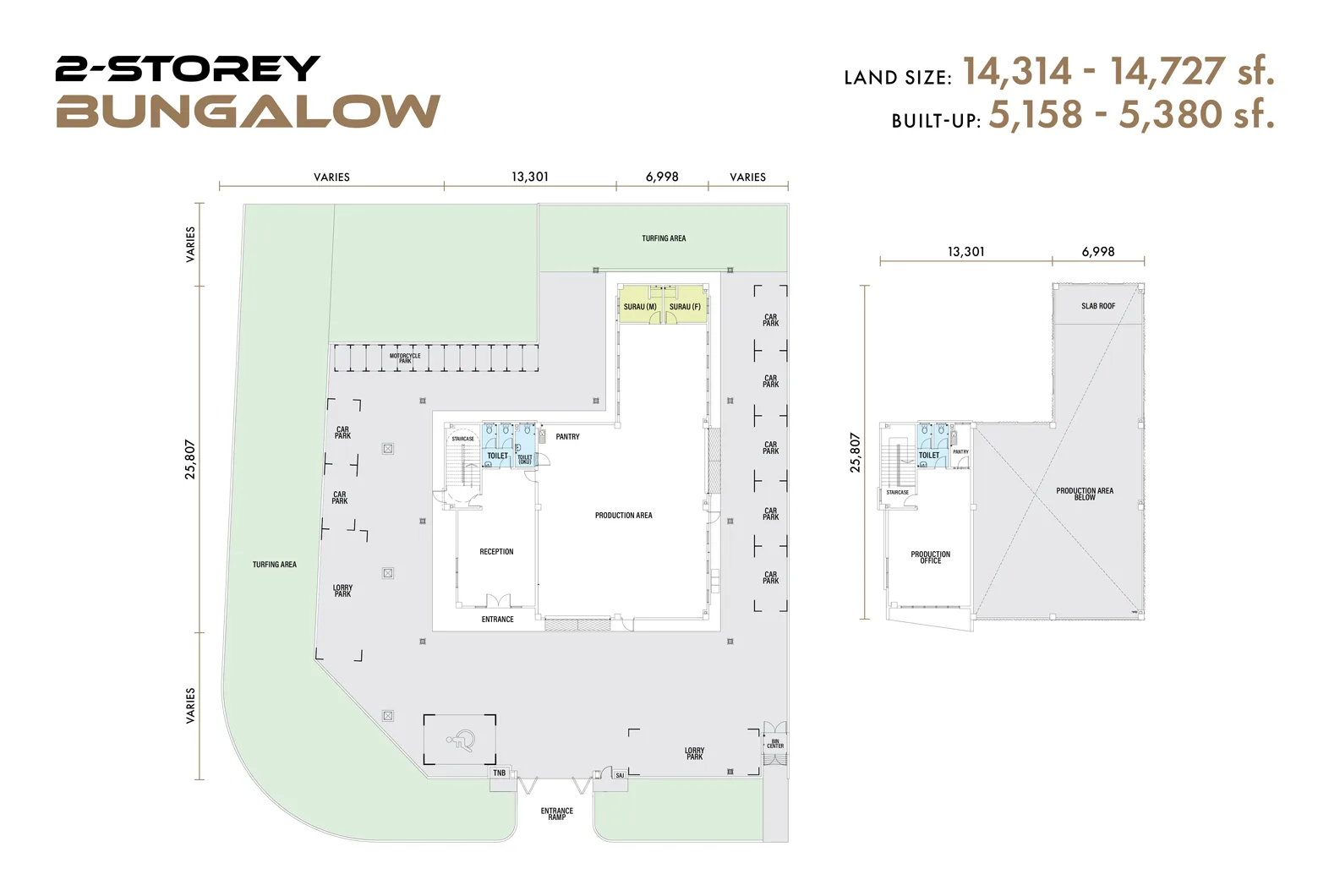
Bungalow Factory (detached) — up to 5,380 sq ft built-up
Get this floor planInside Setia Edge @ Setia Business Park II
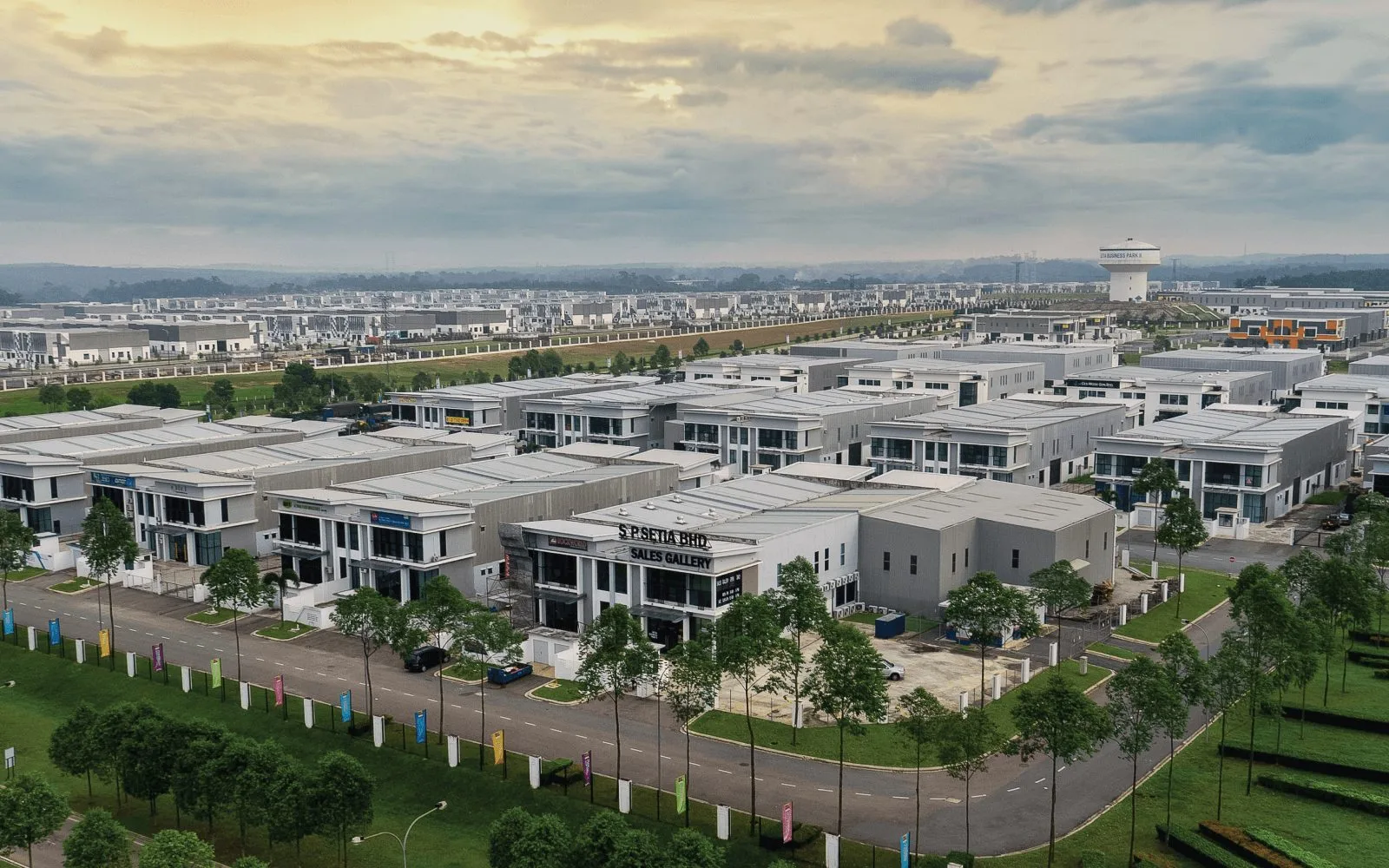

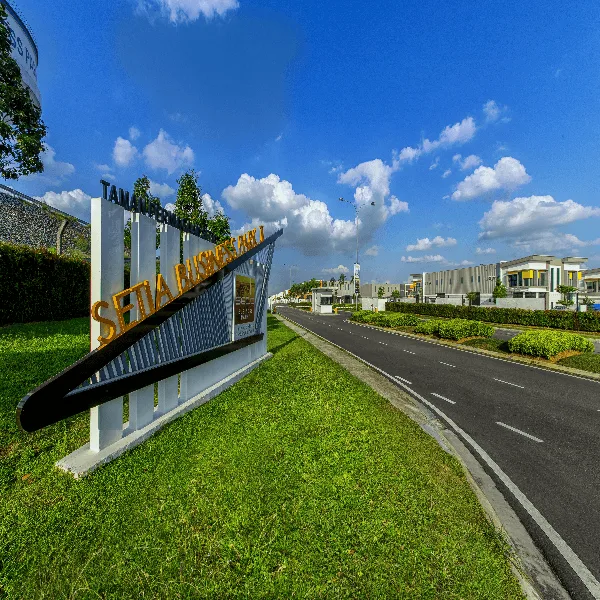
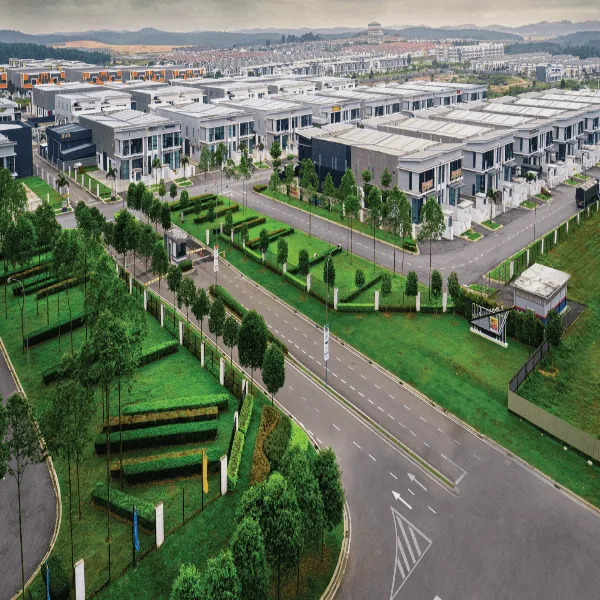
Where Setia Edge @ Setia Business Park II sits
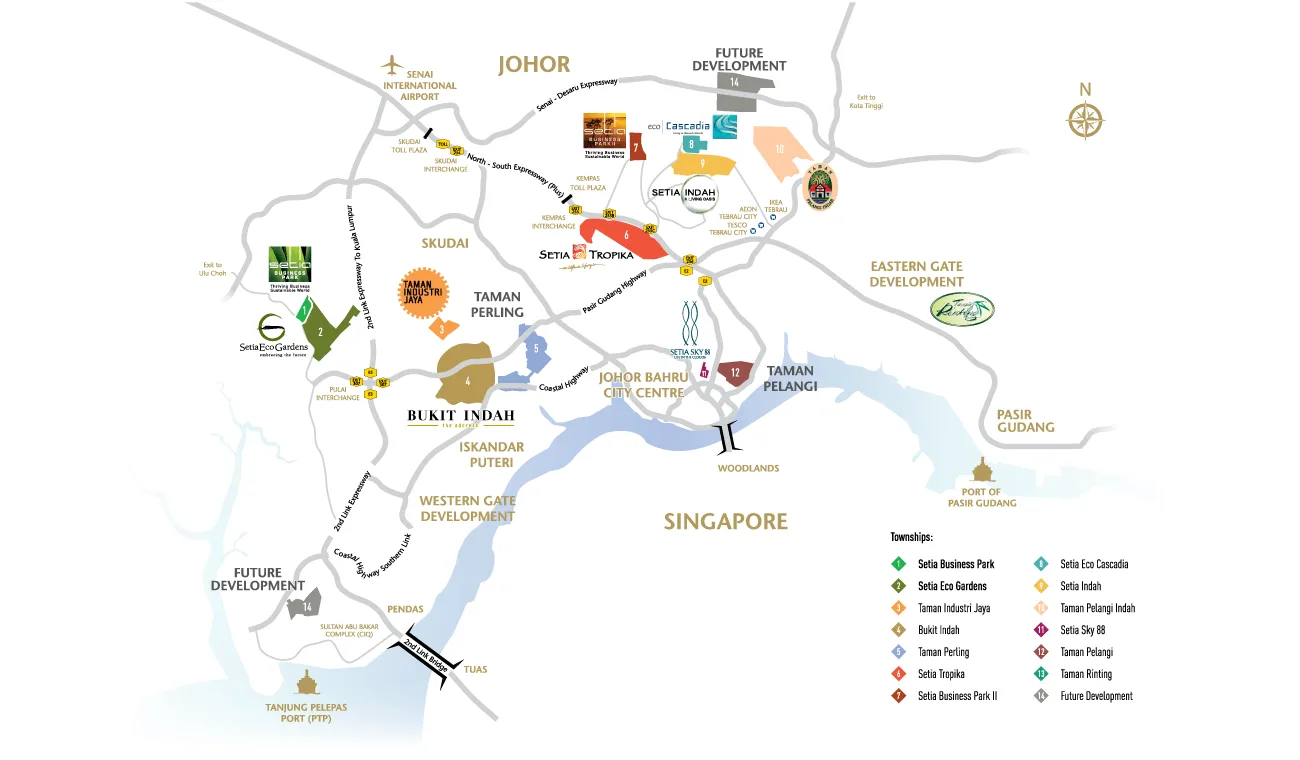
Persiaran Perniagaan Setia, Taman Perniagaan Setia, 81100 Johor Bahru — Mukim Tebrau, Daerah Johor Bahru, under Majlis Bandaraya Johor Bahru, immediately east of Bandar Dato’ Onn and inside the Iskandar Malaysia boundary.
Pinned to the site itself, resolved from S P Setia’s own map link on the Setia Business Park II page. This is not the sales gallery. The gallery S P Setia lists is at Pelangi Indah, 81800 Ulu Tiram — about 7.4 km east of the land. Several listing sites publish the gallery address as the project address.
💬 Ask me about the real drive times- NSE Exit 255C, Bandar Dato’ Onn4.7 kmstraight line, my calculation
- Senai International Airport9.4 kmstraight line · about 18 km by road
- Johor Bahru city centre, Jalan Wong Ah Fook14.3 kmstraight line, my calculation
- Johor-Singapore CIQ, Bangunan Sultan Iskandar14.6 kmstraight line · about 19 km by road
- Johor Port, Pasir Gudang24.6 kmstraight line, my calculation
- Second Link CIQ, Tanjung Kupang27.3 kmstraight line — this park faces the Causeway side
- Port of Tanjung Pelepas32.2 kmstraight line, my calculation
- Senai-Desaru Expressway E223.9 kmpasses north — no interchange on that stretch
There is no housing permit for this project — because factories are not housing, and that removes protections you may be assuming you have
Every residential project page on this website carries a table read from teduh.kpkt.gov.my, the federal housing register: permit number, licensed developer, unit count, permitted price band, certified construction percentage, project status.
There is no such table here, and the reason is not that I could not find one. It is that one does not exist, and the same fact removes several protections that residential buyers get automatically.
Why the register does not cover this
The Housing Development (Control and Licensing) Act 1966 applies to housing accommodation — buildings constructed or intended for use as a dwelling. It is the Act that creates the developer’s licence, the advertising permit, the certified progress returns and the statutory sale and purchase agreement that this website reads for every residential project.
Detached, cluster and link factories are not housing accommodation. The Act does not apply to them, so there is no licence to check, no advertising permit to verify and no progress percentage filed with the ministry.
I searched the register anyway. Setia Indah Sdn Bhd holds a large housing licence (8118) covering many residential phases — Laman Danau, Summera Grove, Residensi Lili, Pangsapuri Setia Impiana and others. None of them is this project, and none of them tells you anything about it. Those are the company’s housing schemes; this is its industrial one.
What you are actually giving up, stated plainly
This is the part that matters, and it is rarely explained to industrial and commercial buyers:
No statutory late-delivery compensation. Residential buyers get liquidated ascertained damages at a rate fixed by law — 10% per annum of the purchase price for strata, from a date fixed in a statutory agreement. You get whatever your contract says, and nothing more. If the contract is silent, you have to prove your actual loss.
No statutory sale and purchase agreement. A residential buyer signs a form of contract prescribed by regulation, which cannot be varied to their disadvantage. Your contract is a commercial document drafted by the seller’s lawyers, and every clause in it is negotiable — which also means every clause in it is the seller’s to draft.
No Housing Development Account. Money paid by residential purchasers must be held in a ring-fenced account and released against certified stages. There is no equivalent requirement here.
No access to the Tribunal for Homebuyer Claims. That tribunal — fast, cheap, no lawyer needed — hears housing claims only. A dispute over an industrial unit goes to the ordinary courts, with ordinary costs and ordinary timelines.
And no free public progress check. On every residential page on this site you can pull the developer’s own certified construction percentage in about a minute. Here you cannot. Nobody files it.
What to ask for instead
None of the above means an industrial purchase is unsafe. It means the protection has to come from your contract rather than from a statute, so the contract is where all the work is.
A liquidated damages clause with a stated rate and a stated start date. Ask for it explicitly. If it is not there, ask why.
A payment schedule tied to certified construction stages, certified by an independent architect or engineer, not by the developer.
A bank guarantee or a stakeholder arrangement for deposits, since there is no Housing Development Account to hold them.
Confirmation of the land title category and the approved use — industrial land, industrial building approval, and whether your intended activity is permitted on it. This is one of the most common expensive surprises in industrial property.
The company’s residential record as circumstantial evidence. You cannot check this project in the register, but you can check the same company’s housing schemes under licence 8118 — whether any carry a cancelled permit, a Lewat (late) or a Sakit (distressed) status. That is not proof of anything about this project, but it is real, free, public evidence about how this developer performs.
Foreign buyers
Industrial and commercial property sits under a different set of rules from residential. Thresholds, state consent and the acquisition guidelines all differ, and in several situations a foreign interest acquiring commercial or industrial property is required to hold it through a Malaysian-incorporated company rather than personally.
Do not carry over any residential threshold from elsewhere on this website. Get the position for industrial property in this state, for your specific structure, from your own lawyer before you commit.
Federal housing register searched at teduh.kpkt.gov.my on 27 August 2026. No permit exists for this project because the Act does not apply to it.
About S P Setia Berhad
S P Setia Berhad (Registration No. 197401002663 / 19698-X) was incorporated in 1974 and has been listed on Bursa Malaysia since 1993, under the ticker SPSETIA (8664). Because it is a listed company, you do not have to take a salesperson’s word for its financial position — the quarterly filings are public. The land-owning entity behind Setia Business Park II is Setia Indah Sdn Bhd (198901008253 / 185555-H), named in the statutory disclosures for the park’s residential phases and in contractor records for “Setia Business Park II, Zone 4, Mukim Tebrau”.
The FY2025 numbers, filed with Bursa on 27 February 2026: revenue RM4.22 billion (down 20.3% from RM5.29 billion), profit before tax RM969.1 million, net profit attributable to owners RM509.96 million, and net gearing of 0.33 times, improved to 0.31 times as at 31 March 2026 from 0.61 times in FY2021. Total borrowings have come down from roughly RM13 billion in 2019 to RM7.96 billion at the end of 2025. Property sales of RM5.11 billion beat the RM4.8 billion target; the FY2026 target is RM4.6 billion.
The part I would not skip: Q1 FY2026 net profit fell 54% year on year to RM31.12 million on revenue of RM826.54 million, because there were fewer bulk land sales and an unrealised foreign exchange loss of RM14.42 million. That is a reminder that a sizeable slice of S P Setia’s recent earnings has come from selling land rather than from selling buildings. It does not put the group in distress — the balance sheet is the strongest it has been in years — but it is the number an industrial buyer should read before assuming the developer’s revenue base is purely operational.
For a factory purchase what matters more than group earnings is whether the developer finishes and hands over. S P Setia has 42 ongoing developments nationally and ten Johor townships on its own directory, including this one. Phase 1 of Setia Business Park II — 144 units — was reported sold out in the FY2014 annual report, and the park was described as 60% complete at that time. Setia Edge is the final phase of the same park, so you can drive the earlier phases and look at how the roads, drains and units have held up. On an industrial purchase that inspection is worth more than any brochure.
Frequently asked questions
Where exactly is Setia Edge — is it in Tampoi, Ulu Tiram or Iskandar Puteri?
None of those. Setia Edge sits in Mukim Tebrau, Daerah Johor Bahru, at Persiaran Perniagaan Setia, 81100 Johor Bahru, immediately east of Bandar Dato’ Onn. The coordinate is 1.585268, 103.729897 and the Plus Code is 6PH5HPPH+4X. The local authority is Majlis Bandaraya Johor Bahru, which is independently confirmed by the statutory approval reference MBJB/U/2014/14/BGN/46(45) on the park’s own disclosures.
The confusion is understandable, because S P Setia’s website lists an Ulu Tiram address. That is the Setia Business Park II Sales Gallery at Pelangi Indah, 81800 Ulu Tiram — around 7.4 km east of the land. Several listing sites reprint the gallery address as the project address. If a listing tells you this project is in Ulu Tiram, that listing has copied the sales office.
There is a second trap. Setia Business Park — the first one, without the II — is a genuinely separate 183-acre project at Jalan Laman Setia, 81550 Johor Bahru, near the Second Link, about 19 km away in a different mukim under a different council. Marketing lines about proximity to Tuas belong to that park. This one faces the North-South Expressway and Senai.
Can foreigners buy Setia Edge, and what does it actually cost a foreign buyer?
Yes, and industrial title in Johor is the friendliest of the three categories. The Johor land office publishes a RM1,000,000 minimum for foreign acquisition across residential, commercial and industrial alike — and Setia Edge starts at RM3.39 million, so every unit clears it comfortably. More importantly, PTG Johor’s own table imposes no foreign-ownership quota on industrial property, where residential terraces are capped at 20% and apartments at 50%.
The cost side is where the common briefing is wrong. Under Pekeliling PTG Johor Bil. 3 Tahun 2025, effective 1 July 2025, the state levy on foreign acquisition is 3% with a RM30,000 minimum for residential and commercial — but for the industrial category it is a flat 4%, with no minimum stated. On a RM3.39 million unit that is roughly RM135,600, not the RM101,700 a 3% assumption would give you. I have read the circular itself rather than a summary of it.
The other correction: the 8% stamp duty that applies to non-citizens from 1 January 2026 is written against “residential property” as newly defined in the Stamp Act — a house, condominium, apartment, flat, serviced apartment or SOHO used solely as a dwelling. A factory is not that. Non-residential transfers by foreign buyers attract a flat rate rather than the tiered citizen scale, and I would have your solicitor confirm the exact figure against the gazetted order, because this definition is only months old.
You will also pay RM2,000 per title for the consent application, and state consent under section 433B of the National Land Code is mandatory. PTG Johor’s client charter is 2-3 weeks where no JPPH valuation is needed and 1-3 months where it is. One point to raise with your solicitor: PTG Johor’s definition of foreign interest includes Malaysian permanent residents, which is stricter than the federal position and stricter than the stamp duty rules. If you are a PR, confirm your status with the land office before you commit.
What are the unit sizes, floor loading and power supply at Setia Edge?
Three published variants. Cluster Factory: land 8,681-12,085 sq ft, built-up 5,216 sq ft. Link Bungalow Factory: land 13,199-14,168 sq ft, built-up 5,414 sq ft. Bungalow Factory (detached): land 14,314-14,727 sq ft, built-up 5,158-5,380 sq ft. All two storeys.
Floor loading is 10 kN/m² for the production area and the concrete driveway. Electrical supply is three phase, 150 amp, 415 V. Structure is reinforced concrete framework with steel frame and steel trusses; roofing is metal deck or reinforced concrete flat roof; floor finish is hardener in both production and office areas. Each unit gets a fibre termination box and a fibre wall socket.
Note the counter-intuitive detail: the detached bungalow has the largest lot but not the largest built-up. If you need floor area, the link bungalow at 5,414 sq ft gives you more building. If you need yard and four-sided access, the detached is the one.
One naming inconsistency worth raising with the sales team: the marketing copy on S P Setia’s page calls them Cluster, Link-Bungalow and Bungalow, while the specification table on the same page uses “Cluster & Semi-D” and “Bungalow Type A & B”. Ask which nomenclature will appear on the sale and purchase agreement.
What is the price, the completion date and how many units are there?
The price is the only one of the three S P Setia has published: from RM3.39 million, on its own corporate property record, last modified 8 July 2026. There is no per-variant price list on the public site and no upper bound.
The completion and vacant possession date has never been published. One listing portal states 2027 Q3. That figure appears nowhere in S P Setia’s own material, so I will not put it on this page as though it were a developer commitment. What is documented is the construction status: dated site photographs captioned “Infrastructure in progress as at 07/07/2026”, refreshed roughly every two months.
The total unit count has never been published either. Numbers of 32 and 36 units circulate on listing portals. I could neither confirm nor refute them, so they are not on this page. What is on the public record is that Phase 1 of the wider park comprised 144 units and sold out, per the FY2014 annual report.
I get the current price list, the lot schedule and the specification sheet direct from S P Setia. Message me and I will send you what is accurate on the day you ask, along with the answers to the ceiling height and roller shutter questions, which are the two things I would want in writing before signing anything here.
Is Setia Edge protected by the Housing Development Act, and does that matter?
No, and it matters a great deal. Section 3 of the Housing Development (Control and Licensing) Act 1966 defines housing accommodation and then expressly excludes “an accommodation erected on any land designated for or approved for commercial development”. Industrial and commercial products fall outside the Act entirely.
The practical consequences: there is no statutory Schedule G or H sale and purchase agreement — the developer’s own negotiated contract governs, and its terms can be materially less favourable than the prescribed form. There is no statutory defect liability period, no HDA-prescribed formula for liquidated ascertained damages, no mandated completion date, and no prescribed payment schedule. There is no advertising permit and developer’s licence requirement. And the Tribunal for Homebuyer Claims has no jurisdiction — your recourse is the courts or whatever dispute mechanism the contract contains.
There is one more difference that catches sub-sale buyers later. Under the HDA a developer must confirm its records for a fee capped at RM50 when you sell before the title issues. Outside the HDA, obtaining the developer’s consent is the seller’s problem and the fee is whatever the contract says.
None of this makes the purchase a bad idea. It makes the sale and purchase agreement the single most important document in the transaction. Have a solicitor who does industrial work read it clause by clause, and budget for that properly — it is not the same job as reviewing a Schedule H.
How much more do I pay in assessment and utilities on an industrial title?
Materially more, and this is the number most first-time industrial buyers underestimate. Majlis Bandaraya Johor Bahru — the council for this site — publishes its assessment rates as a percentage of annual value: residential and others 0.08%, serviced apartments 0.22%, commercial 0.23%, and industrial 0.24%. Industrial is three times the residential rate.
Water is the bigger jump proportionally. Ranhill SAJ, the Johor operator, charges domestic users RM1.05 per cubic metre for the first 20 m³ with a RM10.50 minimum, and non-domestic users RM4.15 per cubic metre for the first 35 m³ with a RM41.50 minimum, rising to RM5.30 above that. Note that Ranhill SAJ uses a single non-domestic tariff — commercial and industrial are not priced separately.
Electricity changed shape on 1 July 2025. TNB now groups non-domestic tariffs by voltage level — low, medium and high — rather than by activity type, so the old commercial-versus-industrial tariff split no longer exists. Maximum demand is split into a capacity charge and a network charge, and the ICPT surcharge has been replaced by a monthly AFA. In practical terms: at the same voltage level, a commercial and an industrial user now pay the same rates. What drives your bill is your voltage level and your load profile, not what your title says.
I am deliberately not quoting sen-per-kWh figures. TNB’s public HTML pages still display the 2014 tariffs and the current rates render client-side; the extractable tables I found were third-party and internally inconsistent. Build your operating budget from a TNB quotation for your actual load, not from a number on a property page.
What loan margin can I get on an industrial property in Malaysia?
Higher than most people expect, but it is bank credit policy rather than a regulated ceiling. Bank Negara’s 70% loan-to-value cap applies only to the third and subsequent outstanding housing loan — it is a residential rule. There is no BNM cap specific to commercial or industrial property.
As a documented example from a bank’s own published page rather than a comparison site: Alliance Bank’s commercial property loan advertises a margin of financing of up to 85% plus 5% for credit insurance and entry costs, tenure up to 30 years or age 70, and eligibility explicitly open to both Malaysians and foreigners. That is a bank’s own published term sheet, not a broker’s summary.
What I could not verify from any bank’s own page is a factory-specific or warehouse-specific margin, or a documented haircut for non-resident borrowers. The 60-70% figure often quoted for foreign buyers is unsourced. If you are financing from outside Malaysia, get an indicative letter before you pay a deposit — that is the single most common way an industrial purchase goes wrong.
One practical point: valuation on industrial property is more conservative and slower than on residential, because comparables are thinner. Build extra time into your financing condition in the sale and purchase agreement.
Is there an oversupply problem in Johor industrial property?
No — and the contrast with the rest of the Johor market is stark. NAPIC’s Property Market Report for full-year 2025, Southern Region, puts Johor’s unsold completed industrial stock at 89 units, against 212 unsold under construction in 2024 falling to 136 in 2025, and zero unsold not-yet-constructed. For context, Johor had 173 unsold completed industrial units in 2023 and 352 in 2021. The trend is downward. Johor industrial transaction value rose 44.0% year on year to RM9.57 billion.
Compare that with the commercial side of the same report. Johor’s unsold completed shops stood at 1,146 units in 2025, with unsold under construction rising 30.9% to 1,351 and unsold not-constructed more than doubling to 135. NAPIC states plainly that unsold completed shops nationally were concentrated in Johor, Sabah and Sarawak, with Johor holding the largest share at 17.7% of volume and 19.6% of value. Johor occupancy for shopping complexes was 73.5% and for purpose-built offices 66.4%.
So if you have read that Johor is oversupplied, the honest answer is: the residential and shop-lot segments are, and the industrial segment is not. That is why CIMB Securities has described Johor as a two-speed market — favouring industrial and landed, cautious on high-rise residential.
Two things I could not verify and therefore will not publish: a Johor industrial vacancy rate, which neither NAPIC nor any consultancy publishes, and a JB industrial rental rate in ringgit per square foot per month from any named professional source. Broker websites circulate ranges. I would not price an investment on them, and I am not going to print them here as though they were market data.
Does the JS-SEZ and the Johor data centre boom actually help a RM3.4 million factory here?
Partly, and it is worth separating what is real from what is atmosphere. The Johor-Singapore Special Economic Zone agreement was signed on 7 January 2025, covering 3,588 km² across nine flagship areas — Setia Business Park II sits within Johor Bahru city territory, Flagship Zone A. The incentives are concrete: 5% corporate tax on qualifying income for 10-15 years, a 15% flat personal rate for knowledge workers for 10 years, investment tax allowances and stamp duty exemptions, with the MIDA window running from 1 January 2025 to 31 December 2034. Since October 2025 MITI has approved fast-track manufacturing licences in seven working days.
The scale of investment is real too: RM76.98 billion approved in 2025, RM5.49 billion in Q1 2026, and 57% of cumulative approved investment now at implementation stage. What has not happened yet is the JS-SEZ Master Plan itself, expected around December 2026 at the Annual Leaders’ Retreat. Until it lands, the zoning detail behind the incentives is not fully public.
The data centre story is genuinely enormous but only indirectly relevant here. Knight Frank’s Data Centre Atlas 2026 puts Johor’s live IT capacity at 1,110 MW, third in Asia-Pacific behind Tokyo and Singapore, with an incoming pipeline of 8,542 MW — the largest in the region — and colocation vacancy at 0.7%. Johor’s approved digital investment stands at RM42.73 billion, of which RM40.3 billion is data centre and cloud.
How that reaches a factory buyer is through land pricing and the tenant pool, not through a data centre next door. JLL puts Johor’s average industrial land price at RM86 per square foot in 2025, up 8.4% year on year, with prime data-centre-adjacent land in Iskandar Puteri at RM120-150 psf. CIMB Securities quotes RM150 psf for prime Johor industrial land against RM70-80 in 2024 — a much steeper rise that cannot be reconciled with JLL’s series, so I quote both and label them by segment rather than pick one. What all sources agree on is direction, and that the supporting-industry tenant pool around these projects is expanding. That is the mechanism, not the headline.
How far is Setia Edge from the checkpoint, Senai Airport and the ports?
S P Setia publishes no distance table at all for this park — the location block on its pages is a flat image with no figures on it. So every number below is my own calculation from the site coordinate 1.585268, 103.729897, using great-circle distance for straight line and a road-graph router for driving. I would rather show you my method than reprint a marketing figure I cannot source.
Straight line: Senai International Airport 9.4 km, Johor Bahru city centre 14.3 km, the Johor-Singapore CIQ at Bangunan Sultan Iskandar 14.6 km, Johor Port at Pasir Gudang 24.6 km, the Second Link CIQ at Tanjung Kupang 27.3 km, and the Port of Tanjung Pelepas 32.2 km.
By road, roughly: Senai Airport about 18 km and 19 minutes, the Causeway CIQ about 19 km and 19 minutes, Johor Port about 31 km, PTP about 41 km. Treat driving figures as plus or minus 15% — routing engines miss newly opened link roads, and none of these account for real Johor traffic at shift-change hours.
Highway access: the serving expressway is the North-South Expressway E2, and the nearest practical interchange is Exit 255C Bandar Dato’ Onn at about 4.7 km straight line. Exit 255B Setia Tropika and Exit 255 Kempas are at similar distances. The Senai-Desaru Expressway E22 passes about 3.9 km north but has no interchange on that stretch — access to it is indirect, and I would drive it yourself before assuming otherwise.
Get the price list, the lot schedule and the specification sheet
Tell me the machinery you are installing, the power load you need and whether you are buying to occupy or to lease out. Those three answers decide which lot in this park is right for you far more than the price psf does — and I will tell you if the answer is a different park.
Industrial title. Not covered by the Housing Development Act — read the FAQ on that before you commit.
Louis Koh
11 years in Malaysian property · Johor Bahru & Kuala Lumpur new launches · English & 中文
I work with cross-border buyers from Singapore and with local investors. I’ll tell you when a project isn’t right for you — that’s usually worth more than the brochure.
Published 2026-08-04 · Last verified 2026-08-04 against S P Setia Berhad’s published project material. Unit availability, pricing and completion dates are set by the developer and subject to change. This page is marketing information, not an offer or a contract.
Ask a specific question
If you would rather not use WhatsApp, use this. I answer them myself. Only your name and one contact method are required.
Developer: S P Setia (8 developments on this site)
Where it is: Tebrau, Johor Bahru (JB), Johor